
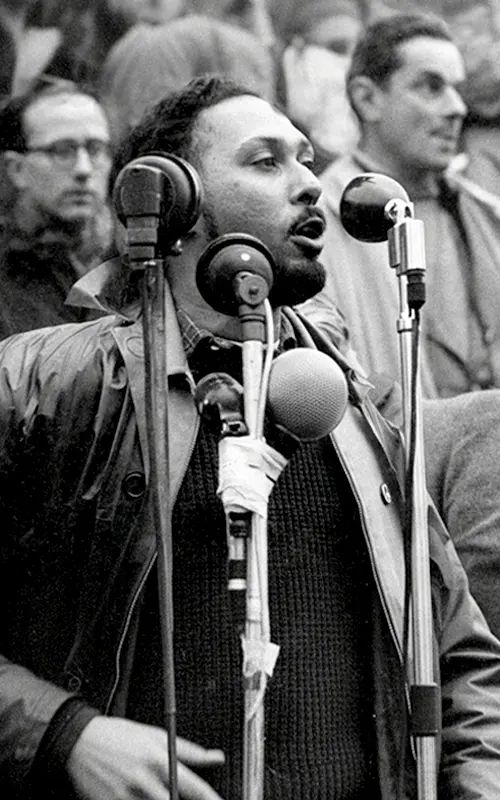
Stuart Hall was a Jamaican-born British sociologist, cultural theorist, and political activist. Born in Kingston in 1932, he moved to the UK in the 1950s and was later dubbed the “godfather of multiculturalism” for his contributions to sociology. Hall was a founding figure of the British Cultural Studies school of thought and, in 1964, co-founded the Centre for Contemporary Cultural Studies at the University of Birmingham, one of the first academic centres to take popular culture seriously. He was responsible for the first Cultural Studies course in the UK, helping to establish the discipline as an international field of study.
Cultural Studies examines how cultural practices relate to wider systems of power, exploring social phenomena such as ideology, class, race, gender, and religion to understand everyday life. Scholars from working-class backgrounds in 1950s and 60s England began questioning the gap between the cultural touchstones promoted by society—books, music, and etiquette meant to teach civility—and their own experiences. Hall was among these scholars, recognizing that mass communications and popular media were reshaping relationships to power and to one another. During his time directing the Centre in the 1970s, he broadened the scope of Cultural Studies to include race and gender, helping to highlight the experiences of marginalized communities.
The Centre for Contemporary Cultural Studies at Birmingham was groundbreaking in its focus on popular culture, such as music, television, and fashion, rather than only “high” culture like classical literature and art. The research demonstrated that mass culture was a critical site for understanding society, politics, and power, and helped elevate Cultural Studies into a respected international discipline. The Centre merged with Birmingham’s Department of Sociology in 2002, and in 2014, its 50th anniversary was marked by the creation of an archive at the Cadbury Research Library, preserving its legacy and Hall’s influential work. Hall remained involved with the project until his death in 2014.
Through his pioneering research, Hall reshaped how people view contemporary society. His work challenged traditional ideas of culture and opened conversations about the relationship between culture and power at every level of social life. He emphasized the importance of understanding multiculturalism and the experiences of marginalized groups, leaving a lasting impact on sociology, education, and public discourse in the UK. Cultural Studies, now a mainstream field taught at universities worldwide, owes much to Hall’s vision, and his ideas continue to influence debates on identity, race, and society.
Hall’s legacy demonstrates the power of critical thinking and the value of examining the connections between culture and society. His work encourages future generations to question accepted norms, understand structural inequalities, and appreciate the diversity of contemporary life. For those inspired by Hall, pursuing sociology or Cultural Studies provides an opportunity to continue exploring the intersections of culture, power, and society.
Stuart Hall on racism:
“Racism is not simply about individual prejudice; it is embedded in social structures, institutions, and everyday practices.”
(Paraphrased from his essays and lectures on race, 1980s–1990s.)
We use cookies to improve your experience on our site. By using our site, you consent to cookies.
Manage your cookie preferences below:
Essential cookies enable basic functions and are necessary for the proper function of the website.
These cookies are needed for adding comments on this website.
You can find more information about our Cookie Policy and Privacy Policy.