
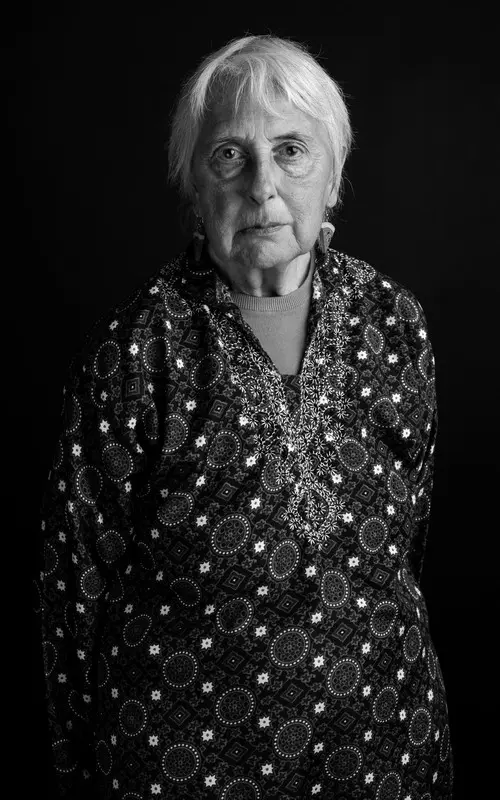
Phyllis Brazier was brought up in a white working-class family in post-war Dagenham, East London/Essex. She left school in 1960 at the age of 16 to work as a trainee Medical Laboratory Technician at Mile End Hospital, East London. It was there that she first met colleagues and friends from Africa, the Caribbean, and South Asia—an experience that broadened her horizons and began shaping her lifelong commitment to anti-racism.
In the late 1960s, having qualified as a Laboratory Technician, Phyllis spent 18 months in Lesotho, Southern Africa, undertaking voluntary service. During this time, she encountered members of a South African liberation movement taking refuge from the apartheid regime. This experience marked the beginning of her political education, deepening her understanding of race, racism, apartheid, and global freedom struggles.
Phyllis moved to Birmingham in 1970 and, after a brief period of involvement in the Labour Party, joined Birmingham Polytechnic in 1973 as a mature student, studying Sociology. There she met her late partner, Aijaz, with whom she worked closely on numerous campaigns—against deportations, racist attacks and murders, and racist immigration laws. She also became friends with Jagmohan Joshi, then secretary of the Indian Workers Association, and his wife Shirley. She and fellow comrades attended a weekly political discussion group held in the back of Joshi’s shop, Progressive Books and Asian Arts.
Over the years, Phyllis played key roles in a range of anti-racist and anti-fascist campaigns. She served as secretary and later treasurer of the Campaign Against Racism and Fascism (CARF). She was actively involved in the campaign to stop the deportation of Baba Bakhataura, who stood as a parliamentary candidate in Ladywood in 1983 on the platform Stop Deportations of Black People Now. She also campaigned in support of the Bradford 12, young men charged with conspiracy for preparing to defend their community against racists and fascists.
Alongside Aijaz, a founder member of the Pakistani Workers Association (PWA), Phyllis helped produce the PWA journal Paikaar, which highlighted anti-racist struggles, events in Pakistan, and international solidarity campaigns, particularly around Palestine, Kashmir, and Ireland.
She was also part of the Kashmiri Defence Campaign in 1984, following police harassment and mass arrests in Alum Rock after the killing of an Indian diplomat in Birmingham. In 1989, following the racist murder of Tasleem Akhtar, she played a leading role in the Tasleem Akhtar Memorial Committee.
Her activism extended into international struggles. She campaigned against the invasion of Iraq and later supported families of men wrongfully imprisoned under anti-terror legislation, particularly women and children. She also worked with charities offering practical and emotional support in such cases.
Throughout her life in Birmingham, Phyllis has been a steadfast campaigner for the Palestinian people. Even in her eighties, she continues to dedicate herself to organising and protesting—against genocide, against the rise of the far right, and in solidarity with oppressed communities at home and abroad.
Phyllis Brazier’s life reflects a deep, consistent, and courageous commitment to justice, equality, and international solidarity.
When asked about the most pressing issue of racism today, Phyllis says:
“The biggest racist event going on today is the genocide in Gaza.”
We use cookies to improve your experience on our site. By using our site, you consent to cookies.
Manage your cookie preferences below:
Essential cookies enable basic functions and are necessary for the proper function of the website.
These cookies are needed for adding comments on this website.
You can find more information about our Cookie Policy and Privacy Policy.