
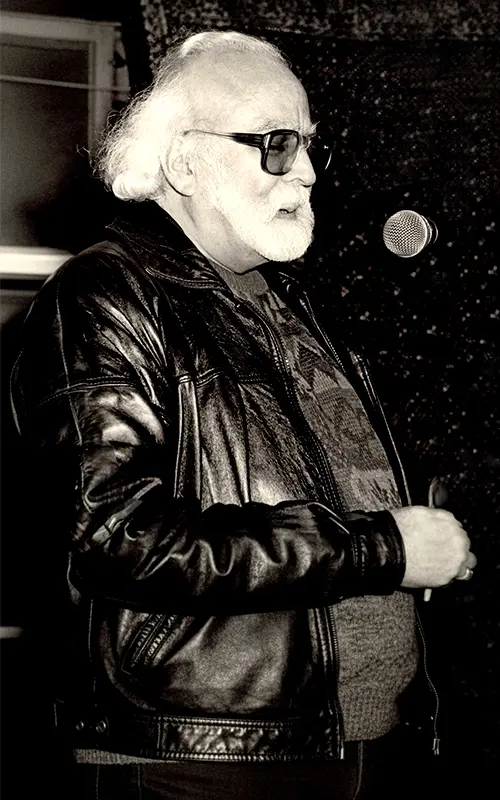
Aijaz Kaleem was a Pakistani-British political activist, anti-racist campaigner, and editor, widely respected for his lifelong commitment to social justice and the empowerment of marginalised communities. Born on February 14, 1937, in Banga, Jullunder District, in what is now East Punjab, India, Kaleem’s early life was shaped by the Partition of India in 1947, which forced his family to migrate to Pakistan and left a lasting impact on his worldview.
Kaleem moved to the United Kingdom in 1963, initially working in temporary jobs in London before joining the Post Office as a parcel sorter. Living in a shared house with migrants from the Caribbean, Africa, and the Indian subcontinent, he became involved in discussions about civil rights, anti-colonial struggles, and global revolutionary movements, developing a commitment to Marxist-Leninist ideology and anti-imperialist activism.
In 1972, Kaleem relocated to Birmingham to assist Jagmohan Joshi at the left-wing bookshop Progressive Books and Asian Arts. He became involved with the Birmingham Revolutionary Communist League and enrolled as a mature sociology student at the City of Birmingham Polytechnic, where he met his lifelong partner, Phyllis Brazier.
Kaleem worked as an advice worker at the Asian Resource Centre in Handsworth from 1979, supporting local communities through translation, advocacy, and organizing campaigns. He co-founded the Pakistani Workers Association (PWA), an independent Black political organization in the UK, and edited its monthly journal, Paikaar, which was published in English and Urdu and featured political analysis, news, and revolutionary poetry. The PWA promoted anti-racist and anti-imperialist struggles locally and globally, maintaining independence from state funding and fostering alliances with other revolutionary organizations, including the All-African People’s Revolutionary Party.
Throughout his career, Kaleem was actively involved in anti-racist campaigns, anti-deportation efforts, and local community organizing, supporting cases such as Satpal Ram, Ashiq Hussain, and Tasleem Akhtar. He also worked in international solidarity movements, supporting struggles in Ireland, Palestine, Kashmir, and anti-war campaigns in Iraq and Afghanistan.
Kaleem’s activism extended beyond political organizing; he was dedicated to education, critical consciousness, and cultural engagement. Through Paikaar, community meetings, and mentorship, he promoted literacy, political awareness, and revolutionary thought. His home in Edgbaston, shared with Phyllis Brazier, became a hub for activists, artists, and intellectuals, where ideas and strategies for social change were developed and shared.
Aijaz Kaleem’s life and work reflect a steadfast commitment to collective liberation, anti-imperialism, and racial justice. He is remembered as a principled activist whose influence strengthened community movements, nurtured critical thought, and contributed significantly to anti-racist and revolutionary organizing in the UK.
A personal tribute by Mukhtar Dar:
Aijaz Kaleem may not be a name that echoes through the halls of power, but his impact resonates deeply within the communities he served and the broader struggle for justice and equality. He reminds us that the true measure of a revolutionary is not found in titles or accolades, but in the quiet, persistent work of nurturing solidarity, fostering critical consciousness, and challenging the status quo. In this, Aijaz was not just an unsung hero; he was a living embodiment of the revolutionary ideal—a man who understood that the fight for justice is not about personal glory, but about the collective liberation of all people.
We use cookies to improve your experience on our site. By using our site, you consent to cookies.
Manage your cookie preferences below:
Essential cookies enable basic functions and are necessary for the proper function of the website.
These cookies are needed for adding comments on this website.
You can find more information about our Cookie Policy and Privacy Policy.