
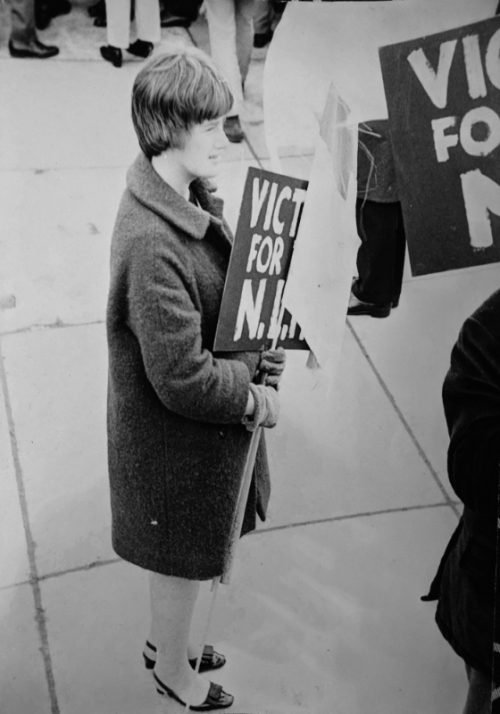
Throughout her whole life, Shirley was a towering figure in the struggle for racial justice – a struggle that had its roots in the historical fight against colonialism and imperialism abroad and the fight against racism and fascism at home, to which it was inextricably linked.
What was so striking about Shirley was not only the sharpness and depth of her analysis but also her unremitting and unwavering belief that wherever there was exploitation and oppression, people would be obliged to struggle against it. This struggle – by ordinary working people – was for her an enduring truth, a political reality from which she never shifted.
For over four decades, Shirley charted one of the most decisive ways forward for political thought and action. For those of us who occasionally wandered away from the cause, or became subject to establishment capture, Shirley’s opinions would serve as a gentle but firm reminder of how far we had strayed. Yet her critical remarks were always delivered, and received, in a positive spirit – fostering even greater comradeship among those working collectively against racism.
In this respect, Shirley was an exemplary teacher, and not only for the generations of students who had the privilege to be in her class. For the rest of us too, she extended the range and depth of our political understanding and imagination, obliging us to engage in the process of critical analysis that forms the basis of any serious political and social action.
No one could appreciate Shirley’s radicalising influence on their lives more than the comrades in the Indian Workers’ Association and their families. She was not only involved in the struggle at their workplaces, but also in their homes and neighbourhoods – working gently, patiently and tirelessly with individual members of their families to counter feudal and chauvinist thinking about gender, culture, caste and religion.
Shirley’s house was always full of visitors from all walks of life. There would be elderly Punjabi wives of retired foundry workers, Urdu poets and philosophers, community workers, sociology graduates, university professors, artists and musicians, visiting officers from India, and young children navigating their way around a melee of adults engaged in deep conversation.
Shirley gave her all and took very little. She never demanded and she never imposed. She handled her illnesses largely by herself, always putting everybody else’s needs first. She would sacrifice anything to ensure that others could have a better quality of life. This was not simply an attitude of mind; it was realised in the lengths she would go to help friends in need. Even after retirement, despite the crippling effects of arthritis and cancer, Shirley continued to involve herself in organisations working with some of the most vulnerable groups in the city, including new migrants, asylum seekers and refugees.
Shirley had a huge generosity of spirit, an indefatigable energy, a genuinely caring nature, depth of understanding, and an acute intelligence – and above all, fine principles and political integrity.
Her political commitments could be traced back to her student days at Birmingham University. As Shirley Fossick she was active in SCARS – the National Student Committee Against Racial Segregation. A report in Guild News, the Birmingham University student magazine, dated 30 November 1961 (p.12), refers to protests by Dr. Vir and Shirley Fossick concerning SCARS inviting reactionary speakers such as Colin Jordan to address students. The article, titled “Dr. Vir to Appeal Against Sentence,” illustrates how early Shirley was prepared to take a principled stand against racism and fascism in public life.
Her understanding of these struggles remained deeply historical and international. Many years later, in a 2011 talk, she reflected on Malcolm X’s famous visit to Smethwick, situating the local fight against racism in Britain within the wider global movement against imperialism and racial oppression.
Just before her husband Jagmohan died, he said in an interview:
“All my life and all my strength were devoted to the greatest cause of all – the liberation of humankind.”
The same could truly be said of Shirley. She firmly believed in one of Chairman Mao’s fundamental principles:
“Of all things in the world, people are the most important.”
We use cookies to improve your experience on our site. By using our site, you consent to cookies.
Manage your cookie preferences below:
Essential cookies enable basic functions and are necessary for the proper function of the website.
These cookies are needed for adding comments on this website.
You can find more information about our Cookie Policy and Privacy Policy.