
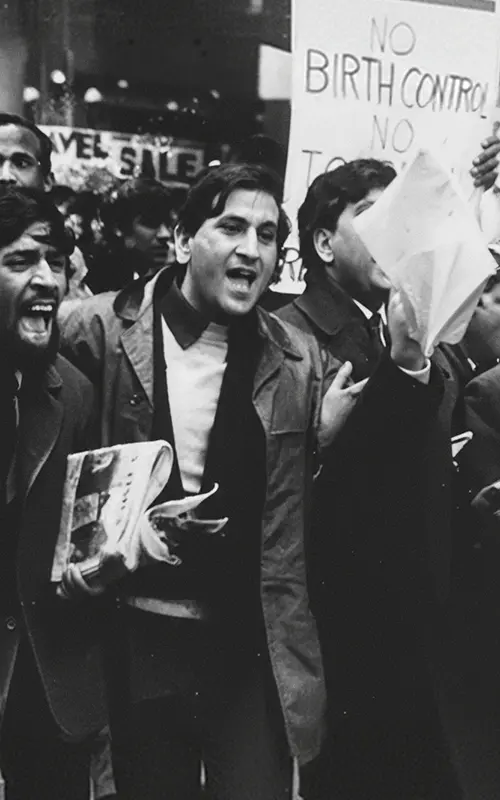
Jagmohan Joshi was born in Hoshiarpur, India, in 1937. In 1958, aged 21, he migrated to Britain to train as an accountant and settled in Birmingham, working at Handsworth Dairies. A committed Communist, he soon joined the Birmingham branch of the Communist Party and developed a lasting partnership with fellow activist Avtar Jouhl. Together they founded the Birmingham branch of the Indian Workers’ Association (IWA) in 1959, linking it with Wolverhampton’s South Staffordshire branch and successfully making the case for a Smethwick branch. Among Joshi’s early initiatives was a parliamentary lobby against restrictive immigration laws and the preparation of *Victims Speak*, a memorandum supported by the Indian High Commission. In 1964, he and Jouhl arranged for Malcolm X to visit Smethwick, where racist campaigning and “colour bar” practices had caused national outrage.
Joshi’s activism extended beyond the IWA. In 1961, he and journalist Maurice Ludmer co-founded the Co-ordinating Committee Against Racial Discrimination (CCARD), which united South Asian and Caribbean organizations to oppose the 1962 Commonwealth Immigrants Act. The group built links with the US civil rights movement and the British Black Panthers. CCARD’s Campaign Secretary, Shirley Fossick—whom Joshi later married—worked alongside him in organizing these efforts.
Following a split in the IWA in 1967, Joshi and Jouhl led IWA (GB), advocating a revolutionary approach independent of state institutions. Joshi became critical of the British Communist Party’s inability to confront racism within the labour movement and called for a separate trade union for racialized minority workers. In 1968, as General Secretary of IWA (GB), he convened the first meeting of the Black People’s Alliance (BPA), uniting fifty South Asian, African, and Caribbean groups in militant resistance to racism. Historians note Joshi’s unique contribution in articulating a shared Black identity that linked all those oppressed by British colonialism, helping forge solidarity across racial and national lines.
At BRIG, we pay close attention to the forces shaping the relationship between state institutions and citizens. Leaders like Jagmohan Joshi have deeply influenced our thinking. His analysis—alongside that of anti-racist thinkers such as Ambalavaner Sivanandan and Stuart Hall—remains as relevant today as it was seventy years ago. Joshi was unshaken in his conviction that the racism of post-war Britain was inseparable from the legacy of British imperialism. He understood that racism, though changed in form, continues to devastate black lives in Britain.
Joshi was also clear about the connection between class and race, sharing Stuart Hall’s view that race is the agency through which class is experienced by black working people. He rejected divisions between colonised peoples, believing that only a united, broad-based alliance could defeat racism. At BRIG, we are proud that our membership reflects this vision—bringing together people from diverse cultural, ethnic, and national backgrounds in a shared struggle for justice.
Ultimately, Joshi believed in the power of ordinary people to shape history. He was no romantic—he knew that liberation would demand commitment, courage, and sacrifice. The baton has been passed from Joshi’s generation to ours, and at BRIG, we are ready to continue that struggle for as long as it takes.
Jagmohan Joshi, speaking on racism and imperialism, observed:
“The racism of Britain is not an accident — it is the child of empire.”
(Paraphrased from speeches reported by Indian Workers’ Association (GB) members, late 1960s.)
We use cookies to improve your experience on our site. By using our site, you consent to cookies.
Manage your cookie preferences below:
Essential cookies enable basic functions and are necessary for the proper function of the website.
These cookies are needed for adding comments on this website.
You can find more information about our Cookie Policy and Privacy Policy.