
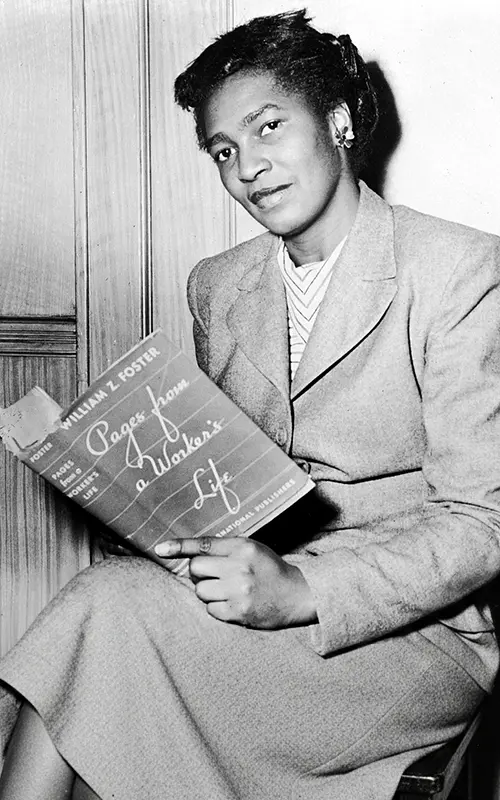
Claudia Jones (born Claudia Vera Cumberbatch in 1915, Trinidad) was a Black, working-class immigrant woman whose radicalism helped shape Black feminist and anti-racist politics across the U.S. and U.K. Migrating to Harlem in 1924, she witnessed the intersecting oppression of race, class, and gender—particularly through her mother’s death from overwork in a garment factory. These experiences led her to identify as a Black communist woman and join the Communist Party USA (CPUSA), where she became a leading writer, organiser, and theoretician.
Within the CPUSA, Jones connected the struggles of Black women, workers, and the poor, formulating ideas that predated what is now known as intersectionality. Her 1949 essay “An End to the Neglect of the Problems of the Negro Woman!” argued that the liberation of poor Black women was essential to the liberation of all. She exposed how Black women suffered “super-exploitation”—paid less than both men and white women, and largely confined to domestic service. Jones viewed this not as a separate issue but as central to Marxist and feminist struggle.
Her revolutionary activity made her a target of McCarthy-era repression. In 1955, under the Smith Act, Jones was deported from the U.S. for her political beliefs. She settled in London, where she immediately began to organise within the Caribbean community. Recognising the power of media and culture in resistance, she founded the West Indian Gazette (WIG) in 1958 alongside Amy Ashwood Garvey. The WIG became Britain’s first major Black newspaper—anti-imperialist, Pan-Africanist, and feminist in its outlook. It provided a platform for Black voices and thinkers such as Frantz Fanon, Nelson Mandela, and James Baldwin, fostering what would become the foundation of modern Black British political discourse.
In the wake of the Notting Hill Race Riots (1958) and the murder of Kelso Cochrane (1959), Jones organised the first Caribbean Carnival in London as a response to racism and as a celebration of Black creativity and resistance. Drawing from the traditions of Trinidad and Harlem, she envisioned Carnival as both cultural expression and political defiance—“a people’s art” embodying their fight for freedom. This Carnival later evolved into today’s Notting Hill Carnival, one of the world’s largest celebrations of Caribbean culture.
Jones’ life and work were grounded in her belief that taking space—physically, intellectually, and politically—was an act of resistance. Whether through journalism, organising, or Carnival, she created spaces where Black people could express solidarity, self-determination, and joy in defiance of oppression.
Buried to the left of Karl Marx in Highgate Cemetery, Jones’ resting place symbolises her lifelong Marxist-Leninist convictions and her challenge to expand Marxism to include the lived experiences of poor Black women. Her ideas influenced later thinkers such as Angela Davis, who described her as “a dedicated Communist who believed that socialism held the only promise of liberation for Black women.”
Claudia Jones remains a towering yet under-recognised figure in global radical history—a revolutionary whose vision of intersectional liberation, anti-imperialism, and cultural resistance continues to resonate today.
Claudia Jones on solidarity and justice:
“Freedom is not a gift. It is won through collective struggle.”
(From her essays and speeches, mid-20th century.)
We use cookies to improve your experience on our site. By using our site, you consent to cookies.
Manage your cookie preferences below:
Essential cookies enable basic functions and are necessary for the proper function of the website.
These cookies are needed for adding comments on this website.
You can find more information about our Cookie Policy and Privacy Policy.