
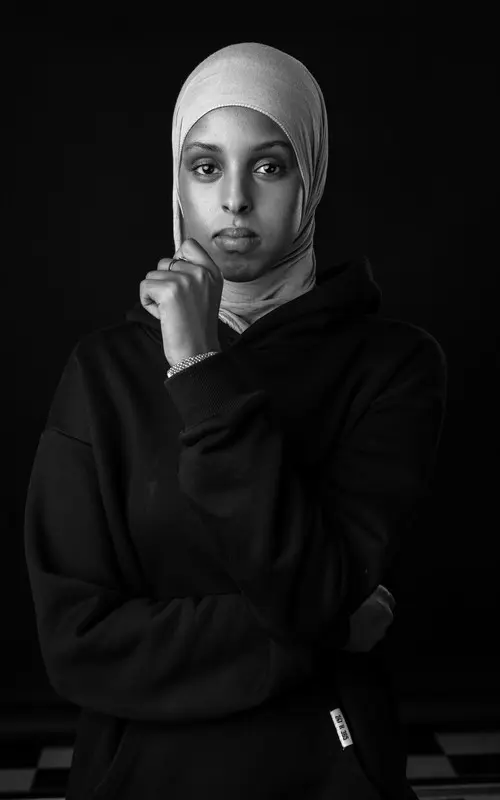
Ayan Aden is Birmingham’s current Poet Laureate (2024–2026), a title she uses to champion poetry as both a cultural force and a tool for social justice. A writer, performer, and organiser, her work is rooted in dismantling systemic racism, reclaiming narratives for marginalised communities, and building platforms that ensure culture is accessible to all.
Her anti-racism journey came sharply into focus in 2019, when she co-founded and led the Justice for Shukri Abdi movement. Following the tragic death of a young Somali schoolgirl, Ayan coordinated international mobilisation efforts that brought together thousands of voices in solidarity. While the campaign did not deliver justice in the courts, it revealed the power of collective action and shone a light on the deep systemic racism embedded in Britain’s institutions. For Ayan, it was a defining experience that underscored how grassroots organising can challenge oppression, even when the outcomes expose the failures of those in power.
The following year, she helped raise over £175,000 in just 28 days for UNHCR’s Project EDEN, a refugee support initiative. This campaign again demonstrated her ability to rally communities behind urgent humanitarian causes, translating online mobilisation into real-world impact.
These experiences have profoundly shaped Ayan’s cultural practice. As founder of Somalinimo UK, she has created one of the UK’s most ambitious platforms for Somali identity, producing Europe’s largest Somali Independence Day celebration in 2025, which welcomed more than 800 attendees and reached millions online. Through projects like the British Somali Poetry Collective and Cultural Dance Sundays, she has carved out spaces that celebrate heritage, confront racism, and ensure young people see themselves reflected in the arts.
She is also the convener of the Birmingham Poetry Network (BPN), which she established to strengthen the region’s poetry ecosystem. Informed by her role on the board of the Birmingham Arts School, Ayan has prioritised accessibility and inclusion in BPN’s vision. The network seeks to ensure that poetry is not siloed or tokenised, but placed at the centre of the city’s cultural conversation. Through pilots such as the Anti-Clash Diary and the Birmingham Poetry Map, BPN creates shared infrastructure for poets and organisations, fostering collaboration and breaking down barriers that often prevent diverse voices from being heard.
As an international award-winning poet, Ayan has performed across the world, bringing her words to audiences to the Middle East , Africa, and Europe. Her poetry, often rooted in Somali oral traditions, speaks to displacement, resilience, and the lived realities of racism. By weaving personal and collective narratives, she challenges audiences to confront uncomfortable truths while also opening pathways to empathy and community cohesion. For her, art is not only expression but resistance- a way to question power, shift perspectives, and bring people together across divides.
Her strategic consultancy work further expands this vision. By partnering with organisations ranging from national arts institutions to grassroots collectives, she has helped bring ambitious projects to life- from safeguarding frameworks to cultural festivals- ensuring that anti-racism and equity are embedded at every stage of design and delivery.
Her forthcoming Somali Week 2026, a week-long cultural programme, embodies this ethos. By combining poetry, dance, sport, and education, it will create a collective platform for Somali identity while showcasing the broader role of culture in resisting erasure and fostering belonging.
In all her work- whether on stage, in classrooms, or through large-scale cultural projects, Ayan is driven by the belief that anti-racism must be lived, not simply spoken. She builds infrastructures, tells stories, and mobilises communities with a clear vision: to create a cultural sector and a society where justice and equity are not ideals but everyday realities.
When asked about what anti-racism means, Ayan says:
“Anti-racism means the fight against oppressive systems and institutionalised racism, to ensure we have a more cohesive and collective society.”
We use cookies to improve your experience on our site. By using our site, you consent to cookies.
Manage your cookie preferences below:
Essential cookies enable basic functions and are necessary for the proper function of the website.
These cookies are needed for adding comments on this website.
You can find more information about our Cookie Policy and Privacy Policy.